
Tata Harrier EV vs Mahindra XEV 9e: Battle Of India’s Electric Titans

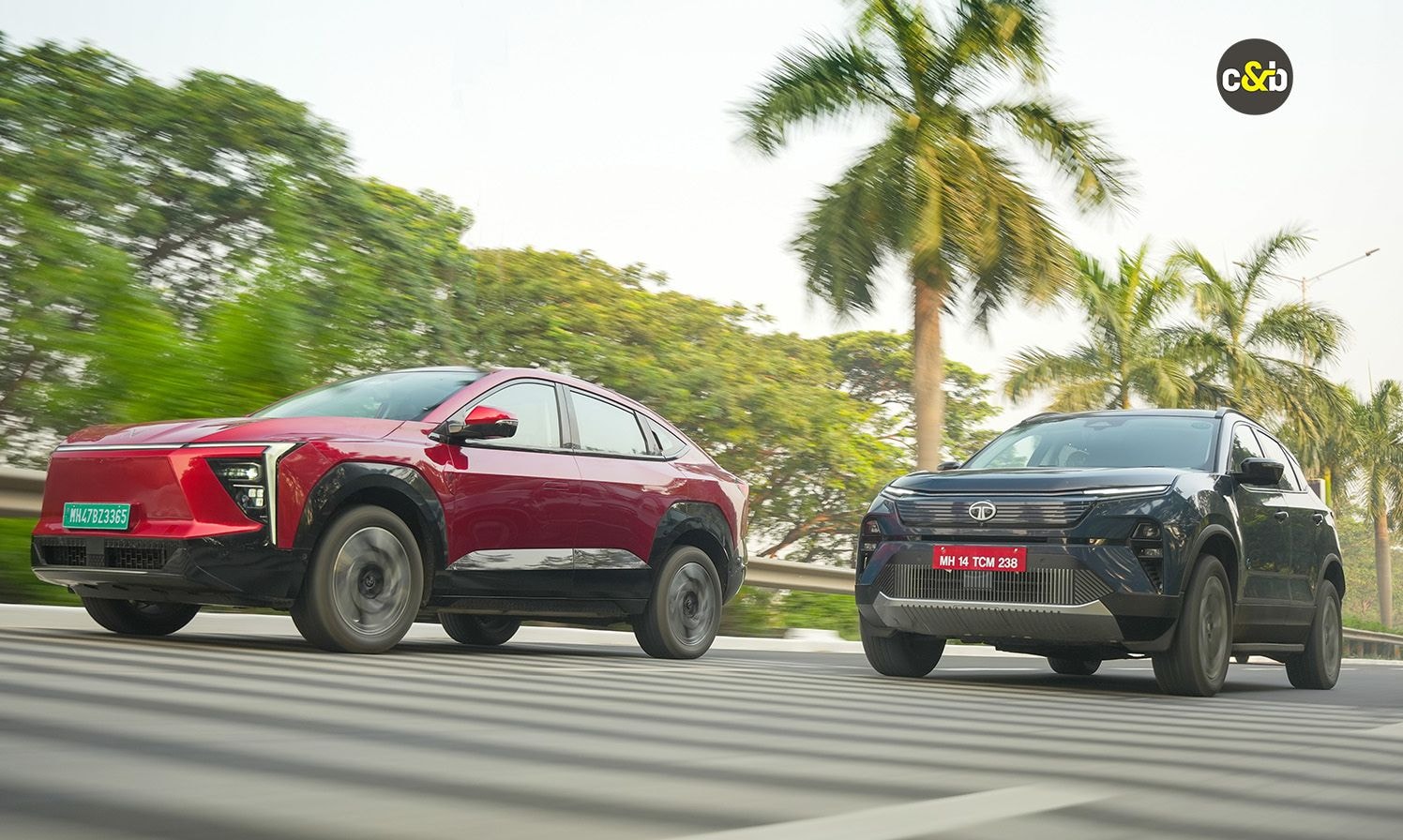
- The Mahindra XEV 9e is tech-heavy, bold, and futuristic.
- And the Tata Harrier EV is rugged, confident, and built for every kind of road.
- Both offer a similar kind of range.
This comparison shouldn’t happen. On my left is the Mahindra XEV 9e- tech-heavy, bold, futuristic. On my right is the Tata Harrier EV - rugged, confident, and built for every kind of road. And I don't think they compete with each other. In my opinion, they are not a direct rival, for it's like comparing Apples to Oranges.
Sure, there are a few similarities: both are priced approximately the same — around Rs 30 lakh on the road in Mumbai. Both are thoroughly India-bred SUVs with a potent electric powertrain, and both make a much stronger value proposition than any of the expensive luxury EVs that were imported to India before they arrived. But that's where the similarities end. And so let me tell you why these two are very different kinds of animals.
Tata Harrier EV vs Mahindra XEV 9e: Exterior, Design, Styling and Dimension
Now, right off the bat, there are two houses of thought here -
The first kind that want their EVs to look radical, should stand out and shout that it's not conventional, but bold, modern and futuristic. The other kind prefer their EV to be traditional. They don’t mind if their EVs look exactly like their petrol/diesel-powered counterparts. And there’s no prize in guessing which one belongs to which house of thought.
Spend some time looking at both, and you'd realise that the XEV9e looks like a concept car that somehow escaped the auto expo show floor, and it still grabs attention on the road. It’s large, imposing, and look at it in finer details where the individual design elements start to pop up. Be it the slim LED DRLs both fore and aft, the coupe-like roofline, and that strong, funky stance – it is Bold.
On the other hand, the Harrier EV keeps things more traditional. It doesn't deviate a lot from the standard diesel Harrier, and some might appreciate it for this. It continues to be a handsome hunk, muscular, stately. This new design language by Tata, of late, has a good blend of modernism, which will age gracefully. And the Harrier’s proportions just make it a tad more special.
| Dimension | Tata Harrier EV | Mahindra XEV 9e |
| Lenght | 4607mm | 4789mm |
| Width | 2132mm | 1907mm |
| Height | 1740mm | 1694mm |
| Wheelbase | 2741mm | 2775mm |
Even in terms of the dimension figure, they are different. The XEV is longer at 4,789x1,907x1,694 mm with a bigger wheelbase at 2,775 mm, while the Harrier is taller and wider, sitting at 4,607x2,132x1740 mm, with a wheelbase of 2741 mm. In terms of overall design, the XEV 9e leans towards style and statement, while the Harrier EV sticks to its SUV-ish roots and road presence. Different personalities yet equally commanding on the road.
Tata Harrier EV vs Mahindra XEV 9e: Interior, Practicality, Ergonomics, Bootspace
Like the exterior, even the cabin of both these electric SUVs is poles apart. One thing you'd notice if you get inside the cabin back to back is that Harrier’s cabin feels large but doesn't have a sense of space. On the other hand, the XEV 9e’s cabin isn't as large but feels more spacious.
Let's start with the XEV 9e in detail. Firstly, I'll talk about things I didn't like. The position of the horn on the steering at 3-9 position, and a slight push on the steering – it honks. If the switches are operated for the ADAS or cut a call, it honks. It’s a bit weird design. Secondly, there are too many German car inspirations here - BMW iDrive-like controller, Porsche-like band on steering, Mercedes-like seat adjustment buttons. It's good if you want these premium-like elements on your car, but otherwise, it feels plain imitation.
Rear visibility has an issue not with the coupe roofline, but with the third headrest. So basically, the view out back is very restricted in the digital IRVM. Overall, for the visibility, it feels obscure, and you feel you are close to the peripheral, but get down, and there's enough space to make a 1bhk out of it.
But on the upside, the cabin feels rich, modern and has good fit and finish if not fantastic. The three screens atop the dashboard are a party piece worth bragging about in every party conversation. Even the sound system here is fabulous. And the front seats are comfier and have good support for longer hours in the saddle. The same cannot be said about the rear seats, as it's difficult to get in. And the seats are flatter and less huggy. Lastly, the headroom, too, is tight for taller passengers owing to its sloping roofline.
Because the ones in the Harrier’s back seat really do offer a much more comfortable seating. The front seats are equally large and good, unlike the ones you see in the Nexon/Curvv EVs. However, compared to the XEV, you sit a bit taller over here. More of an ‘ON’ the seat compared to XEVs ‘IN’ the seat.
The visibility is better here. But on the downside, there are a few ergonomic flaws. And there are a few - no, not few, but quite a few parts carried over from standard car and shared with the affordable EVs in the Tata line-up, which some buyers might find irksome.
For the boot space, the coupe-roofline hides away 663-litre boot space with a usable flat load bay. On the other hand, the Harrier EV offers a 502-litre boot, but it has a raised boot floor owing to the battery pack. Even when it comes to “frunk”, the born-EV architecture of the XEV 9e helps it with a large frunk of over 150 litres, whereas the Harrier EV only gets you 35 litres, which is large enough for a bag or its own charger cable at most.
When it comes to features, both of them have a separate set of party tricks, or gimmicks, call them what you want, to stand out. The Harrier has camera projection for IRVM, and the XEV has groove mode. The Harrier has a summon mode, and XEV also offers autopark. Where XEV has a triple screen with infotainment for the front passenger, the Harrier offers Arcade with gaming. XEV has an adjustable headrest and rear seat recline, and the Harrier has an electric ‘boss’ mode for the front passenger seat. And so the list goes on.
Tata Harrier EV vs Mahindra XEV 9e: Battery, Driving, Performance, Range
Both the Harrier EV and XEV 9e have some seriously large battery packs on offer. There’s 75kWh in the Harrier EV and 79kWh in the XEV 9e, which we have here. However, the Harrier here has dual motors, so it's AWD - or what they call - Quad wheel drive. While the Harrier EV can be had with a single motor, the XEV doesn’t even offer the dual-motor option, making it only RWD.
Then comes the range. We did a real-world range test of the Harrier EV, and it did around 460 km on a full charge. If you get the RWD version of the Harrier, this figure might be just around the 480-500 km mark. Which incidentally is exactly the figure we got from the Range Test of the XEV 9e Pack 3.
Both are admittedly less than their claimed figures, north of 600 km. But look at the bright side. We now have India-made Electric Cars - from Indian brands, which are offering a real-world range of 500 km in a single charge. Things will only get better from here on.
Let’s start with the XEV 9e first, and this one is quick off its feet, more-spritely and feels more eager to move. It has less power than the Harrier EV we have here, but it's also over 100 kgs lighter. There’s also boost mode, which makes it feel even quicker. However, the claimed time is less than the Harrier EV - 6.8 compared to 6.3 seconds. It's fun though, power going to the rear wheels. The steering is light and direct. And the ride is stiffer compared to the more pliant Harrier EV.
Switch to the Harrier EV right after, and you’d notice that the controls over here are relatively heavy. But compared to the XEV, the ride quality of the Harrier is well-absorbent. Be it any kind of road, it just manages to go through, without a budge. At the same time, the XEV 9e has a lot of body movements and may make the passengers uncomfortable.
As for the acceleration and performance, the Harrier EV moves with purpose. With over 500Nm of twisting force, it has a certain grace to it when you smash the throttle, and it moves forward. On the other hand, the XEV9e feels spritely and surprisingly nimble despite its size. While both have drive modes, the Harrier EV gives you more off-road modes, but you get boost mode in XEV. You should choose which is your poison. There are three regen levels as well in both, but neither of them offers a proper one-pedal setup if you are looking for that.
Conclusion
After driving almost every single EV that landed on our shores in the last few years, it's astonishing to see how far our India-bred ones have come after spending a few days with these two. These two might have some similarities, but the differences make them a viable buy for very different sets of buyers. But before that, you also need to know that, in terms of pricing, the Harrier EV here is around 2 lakh rupees more affordable than the range-topping XEV 9e we have here.
But you should consider the Harrier EV if you want your EV to be rugged and have the capability of handling any kind of roads across the country. You should consider it if you like an imposing stance, a comfortable cabin, and have faith in Tata’s now well-established EV ecosystem. It’s for the buyers who value familiarity, comfort, and real-world usability. Someone who wants an electric SUV that feels tough and ready for India. On the other hand, the XEV 9E should appeal to those who want a modern, tech-focused cabin experience, who enjoy the slightly sportier, rear-wheel-drive experience behind the wheel and for those buyers who see their car as an extension of their digital lifestyle.
In the end, it’s not about which one wins — it’s about which one fits you better.
Pictures By Vaibhav Dhanawade


Latest News


 car&bike Team | Apr 1, 2026World Car Awards 2026: BMW iX3 Wins World Car Of The Year TitleThe electric SUV from the German car brand came out to be the biggest winner of the year as it also won the World Electric vehicle 2026 title1 min read
 Jafar Rizvi | Apr 1, 2026VinFast VF MPV 7 To Launch In India Mid AprilVinFast is set to launch the VF MPV 7 in India this month, bringing a new all-electric seven-seater to take on rivals like the Kia Carens Clavis EV and BYD eMAX 7.3 mins read
 Jaiveer Mehra | Apr 1, 2026Chery Land Rover Freelander Concept 97 Previews First Model Under Revived NameplateNew Freelander brand is expected to focus solely on new energy vehicles with plans to expand globally after its China launch.1 min read
 car&bike Team | Apr 1, 2026Auto Sales March 2026: Maruti, Hyundai, Mahindra Cap Off FY26 With Solid NumbersMarch 2026 capped off FY2025-26 on a high note, with Hyundai, Mahindra, Tata Motors, Toyota and Kia posting strong growth driven largely by SUVs and rising EV adoption.4 mins read
 Jaiveer Mehra | Apr 1, 20262026 Mercedes-Benz GLE Facelift Debuts With Updated Looks, New Interior & More Powerful EnginesThe biggest changes come in the form of a revamped cabin with a new MBUX superscreen and the introduction of new six & eight-cylinder engines.6 mins read
 Jafar Rizvi | Apr 1, 20262026 Mercedes-Benz GLS Facelift Unveiled With Updated Engines, ‘Cloud-Based' SuspensionMercedes-Benz has unveiled the updated GLS with revised engines, new MB.OS-based infotainment, refreshed design and a lot more.3 mins read
 Janak Sorap | Mar 31, 20262026 Royal Enfield Guerrilla 450 Apex – First Ride Review: The Update That Changes EverythingAfter riding the updated 2026 Royal Enfield Guerrilla 450 for a round trip of over 140 km from Guwahati to Shillong, the new Apex variant feels like the version of the Guerrilla 450 that should have existed from day one.6 mins read
 Janak Sorap | Mar 25, 2026Ducati Desmo450 MX Review: In PicturesDucati’s first-ever motocross motorcycle, the Ducati Desmo450 MX, promises extreme performance and race-focused engineering, and we recently experienced it at BigRock Dirt Park to find out what it’s really like to ride.1 min read
 Bilal Firfiray | Mar 24, 2026Nissan Gravite Review: Sub-Rs 10 Lakh Seven-Seater That’s PracticalNissan has introduced the Gravite as a practical seven-seater that’s affordable, that’s easy to live with, and value for money. But should you buy it?1 min read
 Janak Sorap | Mar 23, 2026Ducati Desmo450 MX Review: No Road, Only DirtDucati’s first-ever motocross motorcycle promises extreme performance, advanced technology and race-focused engineering, and we got a chance to experience it at BigRock Dirt Park to see what it’s really like.7 mins read
 Seshan Vijayraghvan | Mar 21, 20262026 Renault Duster Review: The Hero Returns, But Does He Deliver?2026 Renault Duster - new design, new platform, modern tech, and most notably, the segment’s most powerful turbo-petrol engine.8 mins read