
More e-Rickshaws In India Than Battery Powered Cars In China

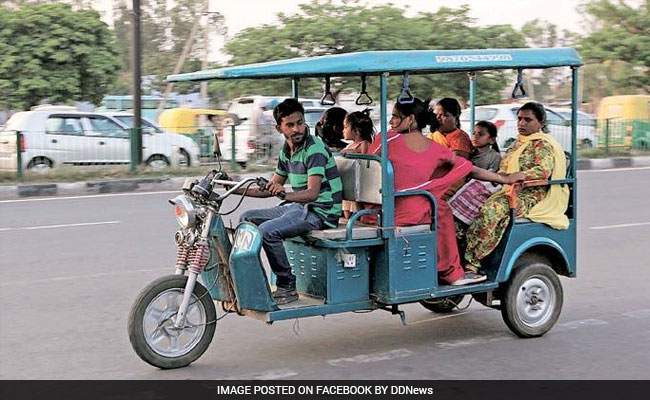
An electric-vehicle revolution is gaining ground in India, and it has nothing to do with cars. The South Asian nation is home to about 1.5 million battery-powered, three-wheeled rickshaws - a fleet bigger than the total number of electric passenger cars sold in China since 2011. But while the world's largest auto market dangled significant subsidies to encourage purchases of battery-powered cars, India's e-movement hardly got a hand from the state.
Rather, drivers of the ubiquitous three-wheelers weaving through crowded, smoggy streets discovered that e-rickshaws are quieter, faster, cleaner and cheaper to maintain than a traditional auto rickshaw. They also are less strenuous than cycle rickshaws, which require all-day peddling. So with more rides possible in a day, the e-rickshaws are proving more lucrative.
As many as 11,000 new e-rickshaws hit the streets every month, and annual sales are expected to increase about 9 percent by 2021, according to consulting firm A.T. Kearney. Three-wheeled vehicles make up a $1.5 billion market, and manufacturers of electric versions include Mahindra & Mahindra Ltd. and Kinetic Engineering Ltd., along with smaller outfits that assemble parts imported from China.
"This is a once-in-a-lifetime, transformational opportunity that we're looking at,'' said Goldie Srivastava, chief executive officer and co-founder of SmartE, an Uber-style app using 800-plus e-rickshaws around New Delhi. "When we look at electric mobility, the focus should be: Are you as a government enabling products that are designed for the future?''
India's dominant ride-hailing startup, Ola, plans to place 10,000 e-ricks in its service by next April.
India is the world's fourth-largest auto market, but previous attempts to boost private electric-car ownership flopped. The government likely scaled back because it fears disrupting an industry that contributes about 7 percent of the total gross domestic product, according to a Bloomberg NEF report in March.
Unlike the estimated 1.35 million passenger EVs cruising around China, the number of electric cars plying Indian roads is a paltry 6,000, according to BNEF data. Chinese automakers sell more than that in three days.
India's largest automaker, Maruti Suzuki India Ltd., won't sell its first EV until 2020.Prime Minister Narendra Modi's administration now is pivoting toward promoting EVs in public transportation and fleet operations - primarily, two- and three-wheelers, taxis and buses. The Ministry of Finance is finalizing a plan to spend about 40 billion rupees ($600 million) in the next five years to improve the nation's charging infrastructure and subsidize e-buses.
"India needs to focus on electrifying two-wheelers and three-wheelers,'' said Amitabh Kant, chief executive of NITI Aayog, a government policy institute helping formulate the new strategy.
Outside an east Delhi metro station, a slew of partly open-air vehicles line the street as commuters hail their rides. They also carry tourists, schoolchildren, crates of fruit and the occasional goat.
Anil Chaudhary, 32, switched to an e-rickshaw from a cycle model two years ago. His income increased, he's able to take longer breaks and he sends money to his wife and three children in Bihar, about 700 miles away. He's already on his second electric model.
"Two months ago, I called my brother from the village and gave him my old e-rickshaw so that he could drive it,'' he said as a goat strolled past.
"I've bought this new one," he said, gesturing toward a glossy, red vehicle adorned with paper flowers and an Indian flag.
Then there's the ameliorative effect that e-ricks have on the toxic air in India, home to 10 of the world's most-polluted cities, according to the World Health Organization.
A total of 635,698 three-wheel vehicles were sold during the fiscal year that ended in March - a 24 percent increase from a year earlier, according to the Society of Indian Automobile Manufacturers. By comparison, about 3.3 million passenger cars were sold, mostly all powered by gasoline or diesel.
One hindrance to the potential growth of EVs is the lack of charging and battery-swapping stations nationwide. India had about 425 publicly available charging points at the end of last year. By 2022, government and private efforts are expected to boost that to an estimated 2,800 charging points, according to BNEF.
Instead of waiting, some companies are starting to build their own infrastructure. SmartE partnered with Delhi Metro Rail Corp. to provide charging near 10 stations, with plans to expand throughout the 214-station system by the end of 2020.
Another hindrance is the lack of bank financing for traditional rickshaw drivers, who typically earn low incomes, said Shishir Agrawal, managing director of Shigan eVoltz Ltd., the parent company of manufacturer GreenRick.
The Gurgaon-based company, which sells e-rickshaws mostly in Delhi and Uttar Pradesh, could more than triple production to 1,000 vehicles a month if that issue was resolved. The potential market for e-rickshaws could be sales of 20 million vehicles a year, he said.
"If the subsidies get better, and easy financing options become available, this market is unstoppable," Agrawal said.
Related News


Latest Cars


Upcoming Cars


Latest News


 car&bike Team | Jul 30, 2026Maruti Suzuki's Hansalpur Plant Hits 10 Lakh Annual Production Capacity; First For Suzuki GloballyWith production beginning at its fourth plant, the Hansalpur facility can now build one million cars a year, making it the largest passenger vehicle manufacturing site at a single location in India.1 min read
 Amaan Ahmed | Jul 30, 2026Made-In-India Honda Rebel 500 Set To Wear Sub-Rs 4 Lakh Price TagRegional BigWing dealer websites incorrectly listed a price of Rs 5.50 lakh for the Rebel 500, but that's not the price at which the locally-built model will be launched.1 min read
 Janak Sorap | Jul 30, 2026Yezdi Adventure Gets Tubeless Spoke Wheels; Scrambler, Roadster Receive New ColoursYezdi has updated its motorcycle lineup with tubeless spoke wheels for the Adventure and fresh colour options for the Roadster and Scrambler.1 min read
 car&bike Team | Jul 30, 2026JSW Motor To Offer AWD Option on Chery iCar V23-Based SUVTest mules of the electric SUV have been spotted testing in India on multiple occasions.1 min read
 car&bike Team | Jul 30, 2026All-New 2026 Bajaj Pulsar Launching SoonBajaj Auto is getting ready to launch the next-generation Pulsar across segments, and the first one is likely to be the new Pulsar 150 or an updated Pulsar N160.1 min read
 Seshan Vijayraghvan | Jul 29, 2026Kia Sorento India Arrival Confirmed With New Teaser: Launch This Festive SeasonThe Kia Sorento has already been spotted testing in India, and it's expected to arrive this festive season.1 min read
 Bilal Firfiray | Jul 30, 2026Kia Syros EV Review: Best EV To Buy Under Rs 20 Lakh?The Kia Syros EV comes into the game with a modern design, spacious cabin, strong performance, decent range and an aggressive pricing. But could it become the new benchmark under Rs 20 lakh?5 mins read
 Jaiveer Mehra | Jul 27, 20262026 Maruti Suzuki Brezza Facelift Review: Bestseller Joins The Turbo ClubWhile Maruti’s facelifts have always tended to bring subtle updates over the outgoing models, the latest Brezza brings some heavy updates under the skin, including a new 6-speed manual gearbox and, for the first time, a turbocharged petrol engine option.1 min read
 Bilal Firfiray | Jul 24, 2026Honda ZR-V Review: Who Is It For?Honda has brought the new ZR-V to India as their current flagship offering. It’s a CBU, it’s a hybrid, and it’s here for a limited few. Who is it for though?1 min read
 Girish Karkera | Jul 29, 2026Mercedes-AMG E53 4MATIC+ PHEV First Drive Review: Just What The Doctor OrderedThere are luxury cars and there are high-performance cars. But what if you want both for the price of one? Mercedes-Benz has a recommendation that promises to tread a fine line between the two – the second generation E53 with a twist.7 mins read
 Shams Raza Naqvi | Jul 15, 2026Ferrari 849 Testarossa Spider Driven: Rs. 11.25 Crore Meets 1,000 bhpWe got behind the wheel of the most powerful convertible from Ferrari. What makes the 849 Testarossa Spider Special? We tell you.1 min read