
Evolution of Wireless Charging for EVs


One of the major aspects of buying an electric car is to get the charging aspect sorted. The traditional way that is majorly used these days worldwide is visiting a charging station with the car. Then the car must be plugged into the charging station, and the rider must wait till the battery is fully charged. Alternatively, if the owner can get solar panels installed, the charging could be completed in the garage. The latest technology in the EV industry is the introduction of wireless charging.

What is wireless charging?
Wireless charging, also known as inductive charging, is a way of charging a device with the help of electromagnetic induction. The main purpose of this charging technique is to eliminate the need for cords and prevent damage.

What is wireless charging for EVs?
Wireless charging for EVs is considerably different from smartphone charging. Inductive charging allows the EVs to charge themselves automatically while the vehicle is parked.
Categories of Wireless Charging
Given the basic concept, there are two ways in which this can go down: -
- Static Wireless Charging: The car is parked in a wireless charging spot in this method. So, in the static position, the car gets charged.
- Dynamic Wireless Charging: This system suggests movement. The car charges itself automatically while traveling on the road.

Wireless Charging Systems
- CWCS (Capacitive Wireless Charging System): The electric field and the ensuing current are used to transfer power. The energy is transmitted between electrodes by electric fields. The combination of transmitter and receiver electrodes makes a capacitor. The space between acts as the dielectric. The frequency range is between 100 to 600 kHz.
- PMWC (Permanent Magnet-Gear Wireless Charging System): The transmitter and receiver are both made of armature winding. The armature winding itself contains synchronized permanent magnets. The electromagnetic field generated produces a torque that rotates the permanent magnets. The coupling of rotating permanent magnets is called magnetic gear.
- IWC (Inductive Wireless Charging System): Basic principles of induction are used for this process. There are two wound-up cables (coils) in play here. Electric current is sent through one coil that creates a magnetic field. That induces an electric current in the second coil!
- RIWC (Resonant Inductive Wireless Charging System): This process requires an oscillating magnetic field operating at high frequency. The logic here is that when two objects have the same resonant frequency and are placed close to each other, energy can be transferred from one object to another.
Related News


Latest Cars


Upcoming Cars


Latest News


 car&bike Team | Jun 29, 2026Delhi EV Policy Approved: Electric Cars Under Rs 30 Lakh To Get Full Tax ExemptionThe new policy offers purchase incentives and scrappage benefits while laying down a roadmap for EV-only registrations across several vehicle segments, including two-wheelers from 2028.2 mins read
 car&bike Team | Jun 29, 2026New-Gen BMW X5 Teased Ahead Of Global Debut TomorrowThe teaser previews a fresh X-shaped lighting signature in a familiar illuminated grille setup.3 mins read
 car&bike Team | Jun 29, 2026Tata Sierra EV Launch Tomorrow: What To Expect?The Sierra EV is expected to share much of its package with the Harrier EV.3 mins read
 Jaiveer Mehra | Jun 28, 2026Nissan Tekton Spied Undisguised Ahead Of July 9 DebutSole image of the SUV showcases the rear design of the SUV.1 min read
 Carandbike Team | Jun 28, 2026Renault Kwid Facelift India Launch On July 3Latest facelift marks the second major update for the entry hatchback since its launch in 2015.1 min read
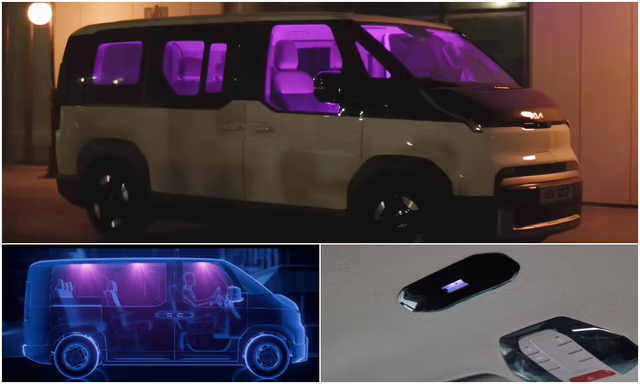 Amaan Ahmed | Jun 27, 2026Future Hyundai, Kia Cars May Feature In-Built UVC SanitiserHyundai Motor Group has unveiled 'Plasma Care UVC' technology, which utilises plasma lamps to safely and effectively destroy bacteria and viruses present inside a car.1 min read
 Seshan Vijayraghvan | Jun 29, 2026Renault Kiger vs Toyota Urban Cruiser Taisor: Which Underdog Deserves Your Money?Both the Kiger and the Taisor promise strong performance, solid features, comfortable cabins and everyday usability, all without breaking the bank. But which of these underrated subcompact SUVs deserves your money? Let's find out.1 min read
 Seshan Vijayraghvan | Jun 29, 2026Skoda Kodiaq RS Review: The Best Kodiaq Yet?The Skoda Kodiaq RS is finally here, and it's every bit as exciting as I expected. But was it worth the wait?7 mins read
 Bilal Firfiray | Jun 28, 2026BMW X6 M60i Review: It’s Back And HOW!The BMW X6 M60i blends a 530bhp twin-turbo V8, with its unmistakable coupe-SUV styling. There’s plenty of character, but is it worth your money?6 mins read
 Janak Sorap | Jun 25, 2026350cc Bajaj Dominar 400 Review: Same Character, Lower PriceA slightly lower displacement engine, a significantly lower price tag and nearly the same performance — the Bajaj Dominar 400 aims to be smarter rather than faster.6 mins read
 Preetam Bora | Jun 25, 20262026 Bajaj Pulsar NS400Z First Ride Review: Smaller Engine, But Should You Buy It?The Bajaj Pulsar NS400Z won our Two-Wheeler Upgrade of the Year. Then new tax slabs happened. Smaller engine, same badge – but does it still deliver?6 mins read