
Explained: All Types Of Hybrid Electric Vehicle Technologies!

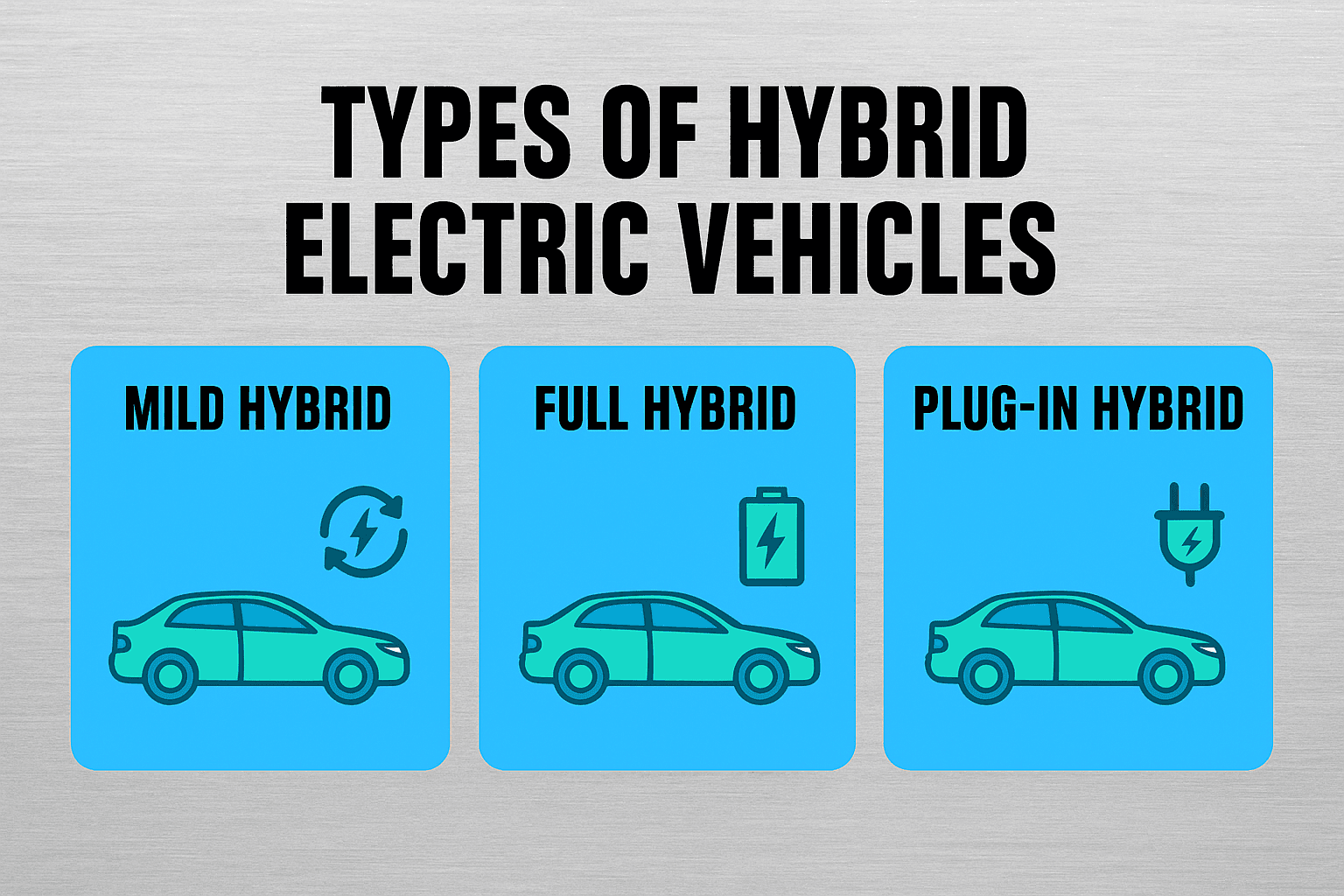
- Mild, full, and plug-in hybrids offer different levels of electric assistance.
- Full hybrids enable electric-only low-speed driving without external charging.
- PHEVs provide 20-80 km EV range and appear mostly in India’s premium segment
Hybrid technology has steadily become a practical choice for Indian car buyers who are looking for lower running costs without jumping fully into the EV ecosystem. With city commutes growing longer and fuel expenses constantly on buyers’ minds, hybrids jump in as a middle path. It offers better efficiency than regular petrol or diesel cars without the charging dependence of pure EVs.
Also Read: Best Chauffeur Driven Cars Under Rs 20 Lakh
But the hybrid space itself has layers: mild hybrids, full hybrids, plug-in hybrids, and then the deeper engineering behind them, such as parallel or series-parallel layouts. Here’s a closer look at everything that sits under the “hybrid” umbrella today.
Also Read: Cars With The Highest Ground Clearance In India
Mild Hybrid
Mild hybrids may not be full electrics, but a fair bit is happening under the skin. The core of the system is a motor-generator, sometimes called an ISG (Integrated Starter-Generator), paired with either a small 12-volt or a stronger 48-volt battery. Unlike a strong hybrid, the motor here isn’t meant to drive the wheels on its own. Instead, it supports the engine in simple but effective ways.
The first job it handles is idle start-stop. When the car is stationary at a signal, the system switches the engine off to save fuel. As soon as the driver lifts off the brake or taps the accelerator, the motor-generator spins the engine back to life quickly and smoothly. This cuts fuel consumption in slow city traffic without any effort from the driver.
The second part is torque assist. During a quick getaway or while building speed, the electric motor provides a small push to help the engine. It’s not a big shove, just enough to keep the engine from working too hard at low RPMs. This makes the car feel slightly smoother and reduces the fuel needed during these short bursts.
Then there’s energy recuperation. When the driver lifts off the accelerator or applies the brakes, the motor-generator works in reverse, acting as a small generator. It converts the car’s motion into electrical energy, topping up the battery each time the car slows down. This reclaimed energy is what powers the start-stop function and the torque assist, making the whole setup self-sustaining.
Brands like Maruti Suzuki typically use 12V systems, while manufacturers such as Mercedes-Benz and some Toyota models, most recently the Fortuner Neo, use 48V setups.
All of this happens quietly in the background. The driver doesn’t need to press any special buttons or change the way they drive. The system just chips in whenever it can, helping with smoothness, improving efficiency a little, and lowering emissions without altering the car’s overall character.
Strong/Full Hybrid (HEV)
Also Read: Best Driver's Cars You Can Buy In India Under Rs. 1 Crore
Strong/Full Hybrid (HEV)
Full hybrids take several steps further than mild hybrids. Instead of simply assisting the engine, a full hybrid system can actually move the car on electric power alone at low speeds. This allows the vehicle to glide silently through traffic, cut fuel use significantly, and make the most of stop-go city conditions where engines typically waste the most fuel.
One of the highlights of a full hybrid system is its ability to switch between three modes: EV mode (electric motor only), engine mode, or a combined mode where both power sources work together. The system decides this on the fly, based on load, speed, and efficiency. Drivers don’t need to intervene; there are no chargers to plug in or buttons to press unless the car offers an optional EV mode shortcut.
Most full hybrids in India use a series-parallel, or power-split, architecture. This setup brings together the strengths of two different hybrid types. At city speeds, it behaves somewhat like a series hybrid: the electric motor handles most of the driving, and the engine steps in mainly to generate power or assist when necessary. On open roads, it shifts to a more parallel-hybrid-like operation, allowing the engine to take direct control of propulsion, where it’s most efficient.
In real-world Indian use, this adaptability is what makes full hybrids such a popular choice. Cars like the Maruti Suzuki Grand Vitara, Toyota Urban Cruiser Hyryder, Honda City e:HEV, Toyota Innova Hycross and Toyota Camry deliver strong city efficiency because the electric motor is used extensively in slow-moving traffic. Many drivers report high fuel economy numbers simply because the engine stays off more often than expected.
Globally, there are full hybrids that use a pure parallel layout, but these are rare in India. The series-parallel design fits India’s traffic patterns better, especially in crowded city environments where frequent starts and stops give the electric motor plenty of opportunities to take over.
Also Read: Top 5 Most Fuel-Efficient Petrol Cars In India
Plug-in Hybrid
Plug-in hybrids sit at the top end of the hybrid spectrum because they offer something neither mild hybrids nor full hybrids can: a usable, everyday electric-only driving range. While a full hybrid relies entirely on regenerative braking and the engine to charge its small battery, a plug-in hybrid features a much larger battery pack that can be charged externally, at home, at work, or through public chargers.
This extra battery capacity allows the electric motor to run the car for anywhere between 20 km and 80 km in typical EV mode driving, depending on model and conditions. For many city users, that range is enough to cover the daily commute without using the petrol engine at all. Once the battery depletes, the vehicle works like a full hybrid.
In EV mode, the car drives like a proper electric vehicle. In hybrid mode, the system optimises energy use, recovering power through regenerative braking and using the engine only when required.
In India, plug-in hybrids remain limited mostly to the premium and luxury segments. Notable examples include the BMW XM and the Lamborghini Urus SE.


Latest News


 car&bike Team | Apr 1, 2026World Car Awards 2026: BMW iX3 Wins World Car Of The Year TitleThe electric SUV from the German car brand came out to be the biggest winner of the year as it also won the World Electric vehicle 2026 title1 min read
 Jafar Rizvi | Apr 1, 2026VinFast VF MPV 7 To Launch In India Mid AprilVinFast is set to launch the VF MPV 7 in India this month, bringing a new all-electric seven-seater to take on rivals like the Kia Carens Clavis EV and BYD eMAX 7.3 mins read
 Jaiveer Mehra | Apr 1, 2026Chery Land Rover Freelander Concept 97 Previews First Model Under Revived NameplateNew Freelander brand is expected to focus solely on new energy vehicles with plans to expand globally after its China launch.1 min read
 car&bike Team | Apr 1, 2026Auto Sales March 2026: Maruti, Hyundai, Mahindra Cap Off FY26 With Solid NumbersMarch 2026 capped off FY2025-26 on a high note, with Hyundai, Mahindra, Tata Motors, Toyota and Kia posting strong growth driven largely by SUVs and rising EV adoption.4 mins read
 Jaiveer Mehra | Apr 1, 20262026 Mercedes-Benz GLE Facelift Debuts With Updated Looks, New Interior & More Powerful EnginesThe biggest changes come in the form of a revamped cabin with a new MBUX superscreen and the introduction of new six & eight-cylinder engines.6 mins read
 Jafar Rizvi | Apr 1, 20262026 Mercedes-Benz GLS Facelift Unveiled With Updated Engines, ‘Cloud-Based' SuspensionMercedes-Benz has unveiled the updated GLS with revised engines, new MB.OS-based infotainment, refreshed design and a lot more.3 mins read
 Janak Sorap | Mar 31, 20262026 Royal Enfield Guerrilla 450 Apex – First Ride Review: The Update That Changes EverythingAfter riding the updated 2026 Royal Enfield Guerrilla 450 for a round trip of over 140 km from Guwahati to Shillong, the new Apex variant feels like the version of the Guerrilla 450 that should have existed from day one.6 mins read
 Janak Sorap | Mar 25, 2026Ducati Desmo450 MX Review: In PicturesDucati’s first-ever motocross motorcycle, the Ducati Desmo450 MX, promises extreme performance and race-focused engineering, and we recently experienced it at BigRock Dirt Park to find out what it’s really like to ride.1 min read
 Bilal Firfiray | Mar 24, 2026Nissan Gravite Review: Sub-Rs 10 Lakh Seven-Seater That’s PracticalNissan has introduced the Gravite as a practical seven-seater that’s affordable, that’s easy to live with, and value for money. But should you buy it?1 min read
 Janak Sorap | Mar 23, 2026Ducati Desmo450 MX Review: No Road, Only DirtDucati’s first-ever motocross motorcycle promises extreme performance, advanced technology and race-focused engineering, and we got a chance to experience it at BigRock Dirt Park to see what it’s really like.7 mins read
 Seshan Vijayraghvan | Mar 21, 20262026 Renault Duster Review: The Hero Returns, But Does He Deliver?2026 Renault Duster - new design, new platform, modern tech, and most notably, the segment’s most powerful turbo-petrol engine.8 mins read