
Cost Of Setting Up An EV Charging Station In India: Requirements & ROI

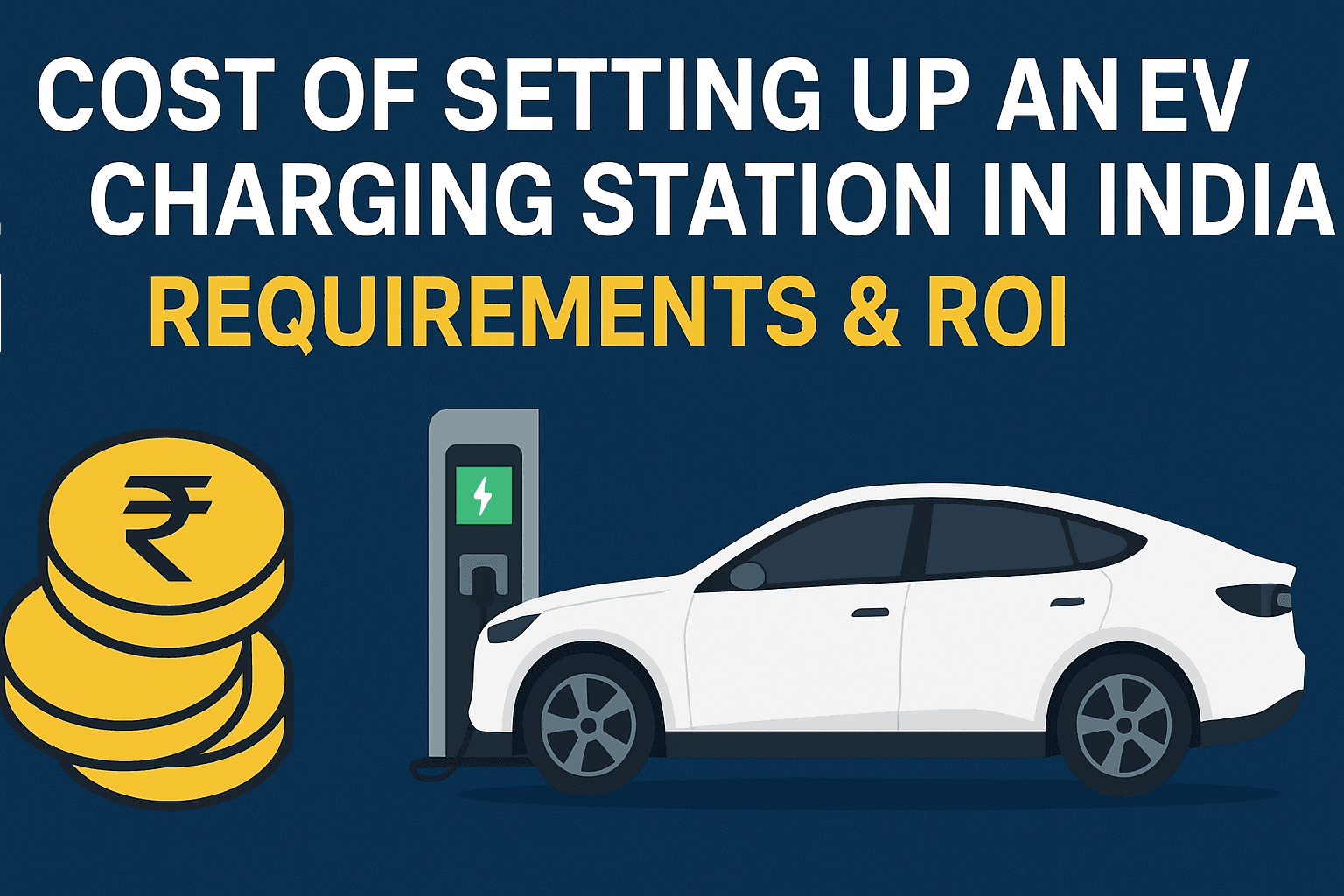
- Typical DC fast-charger costs between Rs 7–12 lakh; high-power units cost more
- You don’t need a license for a public charger, but strict technical standards apply.
- With decent traffic and pricing, payback can be ~18–36 months; utilisation is the key lever.
Introduction
Thinking of setting up an EV charging station in India? This straightforward guide breaks down real setup costs, permits and technical requirements, business models, and a clear ROI example in crisp, no-nonsense information.
Electric vehicle charging isn’t just about sockets and plugs — it’s a small business, a public service and an infrastructure play rolled into one. If you’re reading this, you want clear numbers, the legal basics, and a realistic sense of how quickly the money comes back. Let’s get to it.
1) What types of chargers and their typical cost:
Chargers come in broad types:
- Slow / Wallbox (AC 3.3kW to 7kW) — best for homes, offices and long-stay parking.
- Fast AC (7–22 kW) — useful for malls, workplaces, and hotels.
- DC Fast Chargers (25–150+ kW) — highway plazas, fleet depots, quick top-ups for cars.
Cost ballpark:
- Basic AC point: Rs 30,000 – Rs 1,00,000.
- Mid-tier 22 kW AC: Rs 1–2 lakh.
- DC fast chargers (30–60 kW): Rs 7–12 lakh each (equipment + basic installation).
- High-power DC (120 kW+): Rs 20 lakh+ depending on civil work, transformer, and grid upgrades.
PS: These are ranges — site-specific civil works, transformers, cable runs and grid upgrades can push costs up.
2) What you must have (technical & legal checklist)
- Land/parking: safe, well-lit, convenient access and adequate bay space.
- Power supply: coordination with the local DISCOM for a dedicated meter and load sanction; sometimes transformer/upgrades needed.
- Charger hardware + OCPP-compliant software: for billing, back-end management and interoperability.
- Payment & user interface: RFID, app or UPI integration for frictionless payments.
- Safety & standards compliance: follow Ministry of Power / CEA technical standards and safety norms. Public charging is a de-licensed activity (you do not need a special power supply licence), but you must comply with technical and performance standards and get the necessary local approvals/clearances.
3) Government support and incentives:
India has been progressively funding and incentivising public charging — from FAME-era support to larger, targeted schemes (PM E-DRIVE and state-level incentives). Central and some state schemes now provide capital subsidies, grant windows or reimbursements for infrastructure components — especially for highway fast chargers and public nodes. These programmes reduce upfront risk and accelerate payback for high-utilisation locations. Check the latest state policy where you plan to install; incentives and application processes vary.
Also Read: India’s First Tesla Supercharger Goes Live In Mumbai: All You Need To Know
4) Operating costs to budget for:
- Electricity (energy cost) — your highest recurring cost. Public charging tariffs vary by state and operator — expect a wide band (public AC often Rs 6–12/kWh; public DC fast charging commonly Rs 16–25+/kWh to the customer, while your procurement cost from DISCOM will be lower but varies). Tariff rules are governed by state commissions; typical policy caps also exist (e.g., supply tariff not more than average cost of supply + 15%).
- O&M & staffing — periodic maintenance, software fees, site attendant, insurance.
- Connectivity and payment gateway fees — software and transaction commissions.
- Land lease/property cost — the silent killer of your margin in premium locations.
5) Business models
- Owner-operator (pay-per-use): You buy/install chargers and charge customers per kWh or per minute. Good for malls, highways, fleet depots.
- Operator-as-a-service (OaaS): Vendor installs and operates chargers; you (landowner) get a revenue share or fixed rent. Low CAPEX for the site owner; lower upside.
- Fleet-only / subscription: Dedicated to taxis/logistics; higher utilisation but needs contractual throughput.
- Cross-sell model: Pair charging with café/retail – increases dwell time and non-charging revenue.
6) Realistic ROI example
Numbers matter. Here’s a simple, conservative worked example so you can test the math for your site.
Assumptions:
- One 50 kW DC fast charger: equipment Rs 8,00,000 + installation & civil Rs 2,00,000 → Total CAPEX = Rs 10,00,000. (mid-range real-world figure)
- You sell electricity at Rs 24 / kWh to the customer.
- Your procurement (DISCOM) cost is Rs 8 / kWh.
- Average energy delivered: 100 kWh / day (moderate traffic site).
Calculations:
- Monthly revenue = 24 × 100 × 30 = Rs 72,000.
- Monthly energy cost = 8 × 100 × 30 = Rs 24,000.
- Monthly gross margin = 72,000 − 24,000 = Rs 48,000.
- Payback = CAPEX / monthly gross margin = 10,00,000 / 48,000 ≈ 20.8 months (≈ 1.75 years).
This is a simplified example (doesn’t include staff, software fees, taxes, land rent, downtime or financing costs). But it shows how utilisation and pricing drive payback. Industry reports and operators commonly see payback windows from ~1.5–4 years, depending on location and scale.
Also Read: Tata Motors Opens 10 EV 'Mega Chargers' Across India
7) What improves your returns:
- Increase utilisation — fleet contracts or colocations (food court, petrol pump) are gold.
- Dynamic pricing/premium for speed — charge per minute or premium for ultra-fast charging.
- Lower your electricity procurement — time-of-day tariffs, dedicated supply or rooftop solar + storage.
- Multiple chargers per site — once grid supply is sanctioned, incremental chargers are cheaper.
- State incentives — tap capital subsidies and reimbursements wherever available.
8) Common pitfalls
- Underestimating grid upgrade costs (transformer, cabling).
- Picking incompatible connectors or non-OCPP hardware (locks you to one vendor).
- Putting chargers in low-footfall spots expecting app-based discovery to fix everything.
- Ignoring user experience: lighting, signage, easy payment and shelter matter.
9) Quick step-by-step to get started
- Site survey: footfall, parking time, approach and grid capacity.
- Talk to the DISCOM: provisional load sanction, meter type, tariff class.
- Choose hardware + CMS (OCPP recommended).
- Apply for applicable state/central incentives (if any).
- Install, test, and launch with simple signage and an introductory tariff or fleet tie-up.
- Measure utilisation daily — adjust pricing, promos or partnerships.
10) FAQs
Q: Do I need a licence to operate a public charging station?
A: No special licence — public charging is de-licensed — but you must meet Ministry/CEA technical standards and register with local authorities as required.
Q: Is installing rooftop solar helpful?
A: Yes — solar + smart inverter can cut your effective energy cost and improve margins, especially for daytime sites. Pair with smart billing and net-metering (subject to DISCOM rules).
Q: Which charger gives the fastest payback — AC or DC?
A: It depends on utilisation. DC units cost more but command higher per-kWh prices and quicker turnover. For low-utilisation sites, AC points often make more sense.
Related News


Latest Cars


Upcoming Cars


Latest News


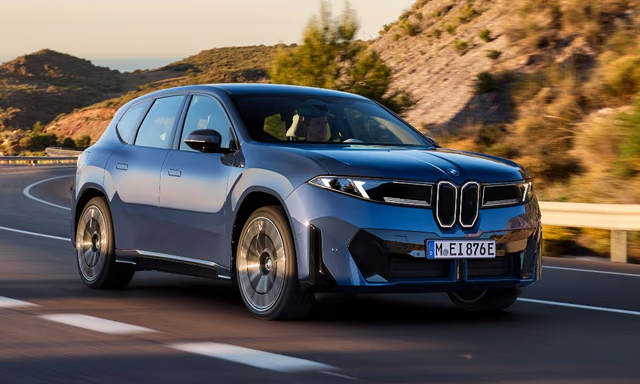 car&bike Team | Apr 1, 2026World Car Awards 2026: BMW iX3 Wins World Car Of The Year TitleThe electric SUV from the German car brand came out to be the biggest winner of the year as it also won the World Electric vehicle 2026 title1 min read
 Jafar Rizvi | Apr 1, 2026VinFast VF MPV 7 To Launch In India Mid AprilVinFast is set to launch the VF MPV 7 in India this month, bringing a new all-electric seven-seater to take on rivals like the Kia Carens Clavis EV and BYD eMAX 7.3 mins read
 Jaiveer Mehra | Apr 1, 2026Chery Land Rover Freelander Concept 97 Previews First Model Under Revived NameplateNew Freelander brand is expected to focus solely on new energy vehicles with plans to expand globally after its China launch.1 min read
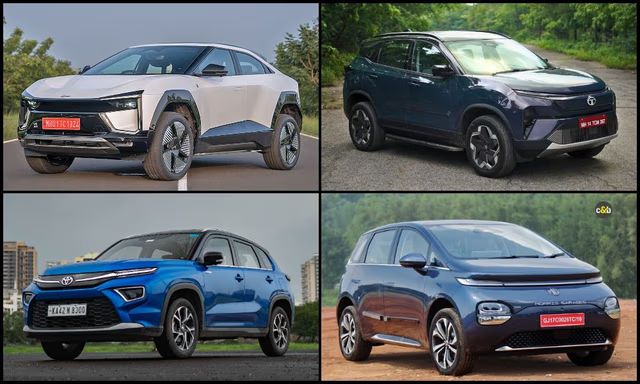 car&bike Team | Apr 1, 2026Auto Sales March 2026: Maruti, Hyundai, Mahindra Cap Off FY26 With Solid NumbersMarch 2026 capped off FY2025-26 on a high note, with Hyundai, Mahindra, Tata Motors, Toyota and Kia posting strong growth driven largely by SUVs and rising EV adoption.4 mins read
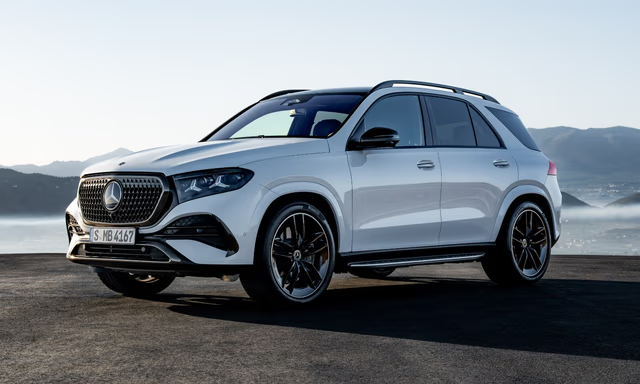 Jaiveer Mehra | Apr 1, 20262026 Mercedes-Benz GLE Facelift Debuts With Updated Looks, New Interior & More Powerful EnginesThe biggest changes come in the form of a revamped cabin with a new MBUX superscreen and the introduction of new six & eight-cylinder engines.6 mins read
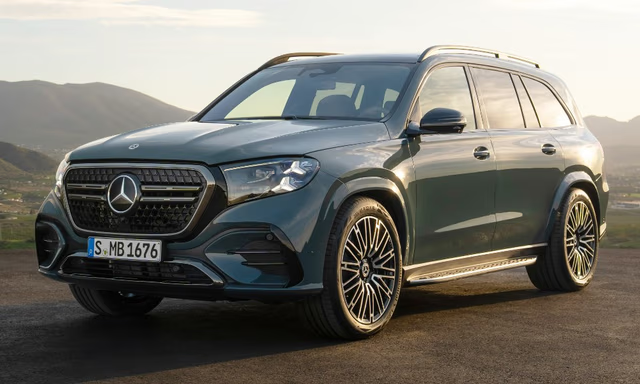 Jafar Rizvi | Apr 1, 20262026 Mercedes-Benz GLS Facelift Unveiled With Updated Engines, ‘Cloud-Based' SuspensionMercedes-Benz has unveiled the updated GLS with revised engines, new MB.OS-based infotainment, refreshed design and a lot more.3 mins read
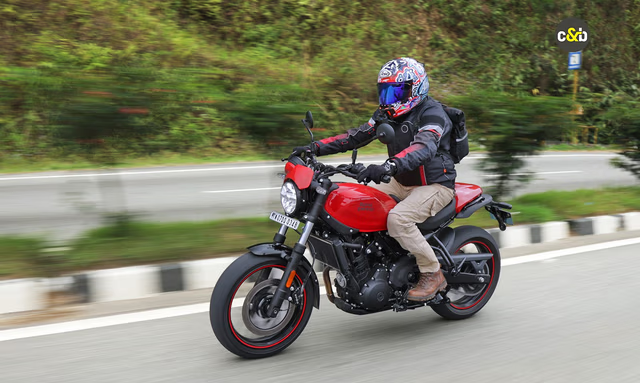 Janak Sorap | Mar 31, 20262026 Royal Enfield Guerrilla 450 Apex – First Ride Review: The Update That Changes EverythingAfter riding the updated 2026 Royal Enfield Guerrilla 450 for a round trip of over 140 km from Guwahati to Shillong, the new Apex variant feels like the version of the Guerrilla 450 that should have existed from day one.6 mins read
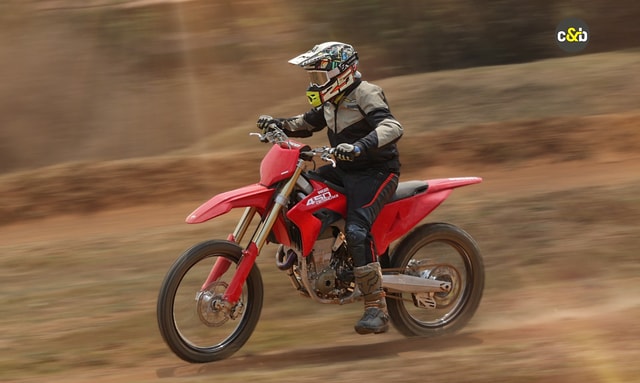 Janak Sorap | Mar 25, 2026Ducati Desmo450 MX Review: In PicturesDucati’s first-ever motocross motorcycle, the Ducati Desmo450 MX, promises extreme performance and race-focused engineering, and we recently experienced it at BigRock Dirt Park to find out what it’s really like to ride.1 min read
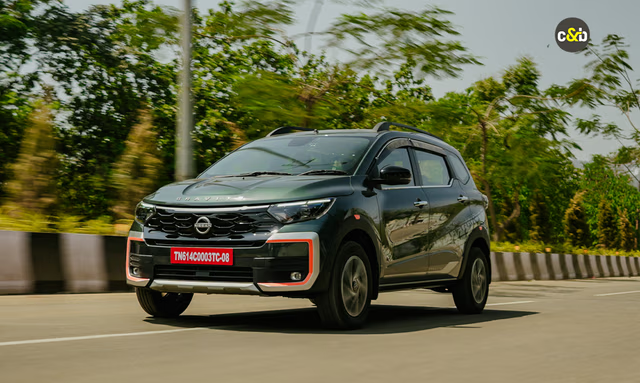 Bilal Firfiray | Mar 24, 2026Nissan Gravite Review: Sub-Rs 10 Lakh Seven-Seater That’s PracticalNissan has introduced the Gravite as a practical seven-seater that’s affordable, that’s easy to live with, and value for money. But should you buy it?1 min read
 Janak Sorap | Mar 23, 2026Ducati Desmo450 MX Review: No Road, Only DirtDucati’s first-ever motocross motorcycle promises extreme performance, advanced technology and race-focused engineering, and we got a chance to experience it at BigRock Dirt Park to see what it’s really like.7 mins read
 Seshan Vijayraghvan | Mar 21, 20262026 Renault Duster Review: The Hero Returns, But Does He Deliver?2026 Renault Duster - new design, new platform, modern tech, and most notably, the segment’s most powerful turbo-petrol engine.8 mins read