
Optimizing Built-in Tyre Pressure Monitoring Sensors


The unsung hero of car performance is tyre pressure. Tires are the exact shape that the manufacturers intended when filled to the correct pressure. Tires require more energy to move when air pressure drops. In the day-to-day bustle of getting from one place to another, drivers might easily forget to check their tyre pressure. Punctures can happen and go unnoticed for a long time. Having an inbuilt sensor that notifies the driver when it's time to inject more air is very important. Simulation provides the means for discovering just the right design for these sensors, which necessitates careful consideration of minor details.

Tire pressure sensors steer the driving experience.
A significant drop in fuel economy is one of the consequences of low tyre pressure. Furthermore, automobiles with common tyres emit substantial greenhouse gases into the atmosphere. Low tyre pressure can also make it difficult to stop the vehicle or cause it to slide on wet surfaces. Automobile manufacturers must install pressure monitoring sensors on wheels that alert drivers if a tire's pressure exceeds the recommended level. Schrader Electronics is the global market leader in tyre pressure monitoring technology.
Schrader Electronics produces 45 million sensors each year and supplies them to major automakers such as GM, Ford, and Mercedes-Benz. Reliability and durability are essential for a sensor to withstand road conditions for the duration of a vehicle's life. When designing for the required functionality, shape, and materials, shock, vibration, pressure, humidity, temperature, and various dynamic forces are considered.

Using FEA to create better sensors
Christabel Evans, a mechanical design engineer with Schrader Electronics, has been employing Finite Element Analysis (FEA) and multiphysics simulation to create successful, efficient tyre sensors for various automobiles.
The Hi-Speed Snap-In Tire Pressure Monitoring Sensor (TPMS), illustrated in the above figure, is a popular Schrader product installed directly on the wheel assembly and checks tyre pressure while the vehicle is moving. When the tyre pressure drops too low, a warning sound notifies the driver that it's time to pull over and re-inflate it.
The engineers at Schrader Electronics used FEA to simulate their designs and iterated the process, reducing experimental costs while also evaluating design performance. If Schrader Electronics intended to apply FEA software to their entire workforce, they discovered that the existing solutions were prohibitively expensive. They used the COMSOL Multiphysics Structural Mechanics Module and the CAD Import Module. To evaluate the software and establish confidence in the results, they proceeded with tests that compared standardised samples with simulations.

Better simulation tools improve sensitivity and durability
The researchers gradually added more natural characteristics to their simulations, ranging from dynamic loads like a centrifugal force to environmental temperature fluctuations and static factors like pressure and crush load. A transmitter consisting of a circuit enclosed in an enclosure and attached to a valve stem with a cap makes up the Hi-Speed Snap-In TPMS. The valve stem attaches to the tire's rim and allows air to flow through. The valve shape on the Hi-Speed TPMS incorporates a rib that aids in the assembly's retention in the rim hole.
Evans and her team selected the best model and improved their design by examining numerous models simultaneously. They experimented with various shapes, materials, and load conditions.
Researchers at Schrader were able to pick up COMSOL Multiphysics software considerably faster than similar simulation products and deploy easier tasks thanks to various license choices. "COMSOL is user-friendly and quick to learn—the engineers picked it up right away," Evans says.
Schrader intends to focus on design and growth for the time being, with some attention on failure analysis, but they expect to strengthen their development-focused approach using simulation tools. Each new design strives to increase driver comfort, environmental effect, and road safety.
Related News


Latest Cars


Upcoming Cars


Latest News


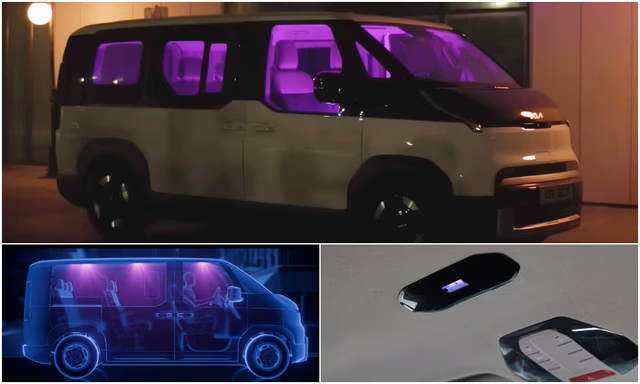 Amaan Ahmed | Jun 27, 2026Future Hyundai, Kia Cars May Feature In-Built UVC SanitiserHyundai Motor Group has unveiled 'Plasma Care UVC' technology, which utilises plasma lamps to safely and effectively destroy bacteria and viruses present inside a car.1 min read
 Amaan Ahmed | Jun 27, 20262026 Maruti Suzuki Brezza Facelift To Be Launched On July 23Launched back in 2022, the current generation of the Brezza subcompact SUV is expected to gain a new engine option, along with a longer list of features.1 min read
 Jaiveer Mehra | Jun 26, 2026New Hyundai Elantra Makes Global Debut: Boxy Styling, Hybrid Powertrain & Pleos InfotainmentNew generation of the Elantra – sold as the Avante in South Korea – adopts Hyundai’s Art of Steel design language.1 min read
 car&bike Team | Jun 26, 2026TVS NTorq 125 Launched With New Colours From Rs. 82,500TVS Motor Company has introduced three new colours for the NTorq 125 Race Edition and two colour options for the disc variant of the scooter.1 min read
 Jaiveer Mehra | Jun 26, 2026New BMW X6 Launched In India At Rs 1.78 CroreThe X6 is offered solely in the hot M60i spec and goes up against the Audi SQ8 and the Mercedes-AMG GLE 53 Coupe1 min read
 car&bike Team | Jun 25, 2026TVS iQube Electric Scooter Crosses 10 Lakh Units Production MilestoneIntroduced in 2020, the iQube is TVS' first high-speed, long-range electric scooter, which has soared to the top of sales charts in recent years.1 min read
 Janak Sorap | Jun 25, 2026350cc Bajaj Dominar 400 Review: Same Character, Lower PriceA slightly lower displacement engine, a significantly lower price tag and nearly the same performance — the Bajaj Dominar 400 aims to be smarter rather than faster.6 mins read
 Preetam Bora | Jun 25, 20262026 Bajaj Pulsar NS400Z First Ride Review: Smaller Engine, But Should You Buy It?The Bajaj Pulsar NS400Z won our Two-Wheeler Upgrade of the Year. Then new tax slabs happened. Smaller engine, same badge – but does it still deliver?6 mins read
 Preetam Bora | Jun 25, 2026Triumph Tracker 400 First Ride Review: What's It Really Like?The Triumph Tracker 400 is here, now with a downsized 349 cc engine. We spent a couple of hours with it to share our first impressions. Is it worth your attention?1 min read
 Preetam Bora | Jun 15, 20262026 Yezdi Scrambler Review: The Update That Changes EverythingThe Yezdi Scrambler gets a comprehensive update with an updated engine, revised chassis, reduced weight and proper features list. Does it deliver? Here’s our take.10 mins read
 Preetam Bora | Jun 10, 20262026 BMW F 450 GS Review: A True GS - But Should You Buy It?The GS badge on a BMW means something and always has. Can the new made-in-India BMW F 450 GS truly live up to that legacy? We spent a few days getting familiar with the F 450 GS to see if it’s worth a buy.12 mins read