
Bearys Institute of Technology Students Build Hybrid Car Powered by Water

Sameer Contractor
1 min read
Jul 05, 2016, 10:47 PM

Key Highlights
- The project uses hydrogen to power the car along with a petrol engine
- The Hybrid Water Car is based on the Maruti Omni
- The Hybrid car uses electrolysis to separate hydrogen and oxygen
Automotive technology has been an ever changing phenomenon with every decade introducing some revolutionary technology, which has helped make people’s lives easier. With conservation being the latest fad, it is the use of alternative fuels that seems to be the trending word. And rightfully so, as efficiency is needed in everything we do; especially with respect to our cars. While auto manufacturers are doing their bit, the young learners at Beary’s Institute of Technology (BIT), Karnataka decided to initiate a project of their own that definitely shows the potential the future has to provide.
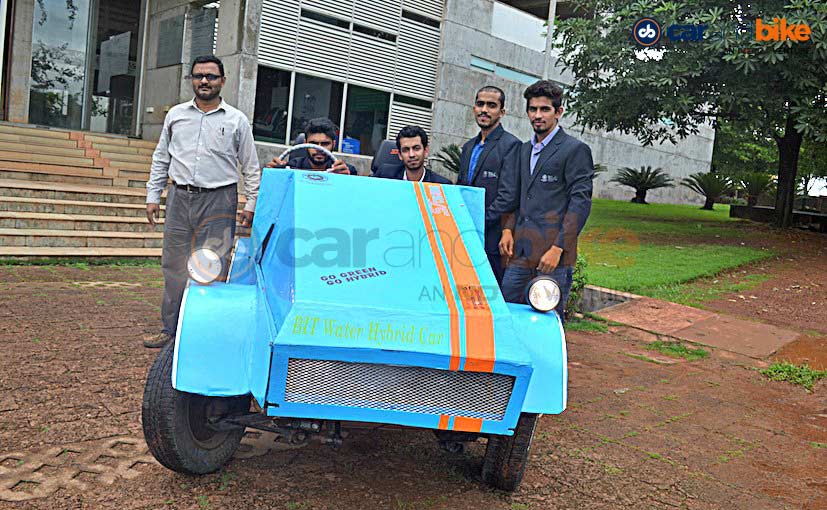 Dubbed as the BIT Water Hybrid Car, final year mechanical engineering students Salman, Yahatash, Mousheen, and Ameer took it up as a project to incorporate an unconventional technology in a vehicle to extract more fuel efficiency. Now, we have options of alternative fuel sources like CNG/LPGs over the years, which work in tandem with our conventional petrol engines to power the vehicle. Fair enough then, the gases are combustible and are put to use as the emissions too are marginally lower on a CNG/LPG powered vehicle. However, BIT's Water Hybrid car as the name suggests uses water to power the vehicle, in a bid to achieve higher fuel economy.
 Perplexed? Not to worry, the students aren't replacing water with oil; instead, they have used hydrogen which is available in two parts in water (H2O) to power their project vehicle. As complicated as it may sound, it really isn't. Using a Maruti Omni to demonstrate their technology, the students used the process of electrolysis to separate hydrogen from oxygen. Hydrogen being highly combustible in nature is supplied to the engine and blends in like a fuel additive.
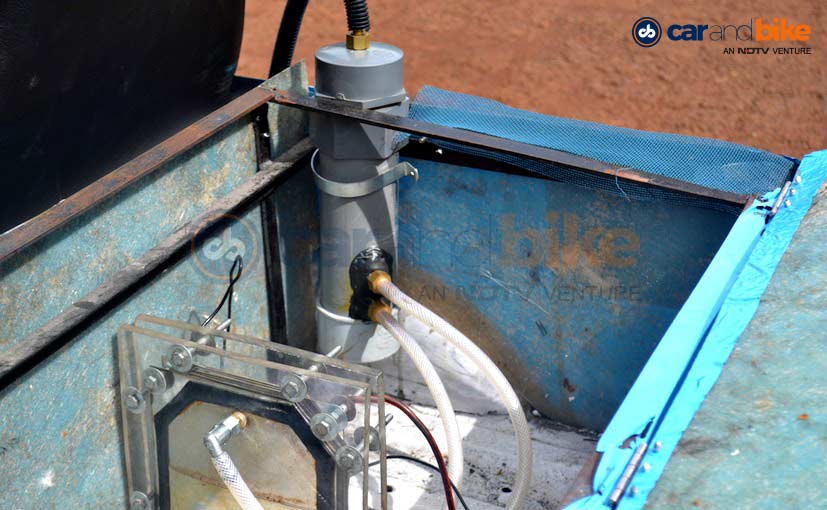
 Essentially, an electrolysis machine is setup in the boot of the project car that has a 1-litre bottle of water ready to be separated into hydrogen and oxygen. Once separated, the hydrogen makes its way to the combustion chamber, while oxygen becomes a byproduct of the process. As the BIT's Mechanical Engineering HOD, Prof. Rounaq Ahmed describes it, the Water Hybrid car's engine gets a higher combustion ratio thanks to the addition of hydrogen, helping burn fuel more efficiently. The stock 800cc three-cylinder petrol engine used on the Omni makes for a 1:8 fuel and air ratio in its stock condition, which the students were able to improve to 1:12 by pumping 10 per cent of hydrogen into the motor.
So you have more combusting properties entering the chamber, which helps the burn process to last longer, while ensuring that the car sips less crude oil as possible. There is no loss in power either, as a matter of fact, a 1bhp increment was noted by the team. The result you ask? Well, the students were able to shoot the fuel efficiency figures by a whopping 42 per cent, up to 25-26 km/l from the average 15-16 km/l.
Essentially, an electrolysis machine is setup in the boot of the project car that has a 1-litre bottle of water ready to be separated into hydrogen and oxygen. Once separated, the hydrogen makes its way to the combustion chamber, while oxygen becomes a byproduct of the process. As the BIT's Mechanical Engineering HOD, Prof. Rounaq Ahmed describes it, the Water Hybrid car's engine gets a higher combustion ratio thanks to the addition of hydrogen, helping burn fuel more efficiently. The stock 800cc three-cylinder petrol engine used on the Omni makes for a 1:8 fuel and air ratio in its stock condition, which the students were able to improve to 1:12 by pumping 10 per cent of hydrogen into the motor.
So you have more combusting properties entering the chamber, which helps the burn process to last longer, while ensuring that the car sips less crude oil as possible. There is no loss in power either, as a matter of fact, a 1bhp increment was noted by the team. The result you ask? Well, the students were able to shoot the fuel efficiency figures by a whopping 42 per cent, up to 25-26 km/l from the average 15-16 km/l.
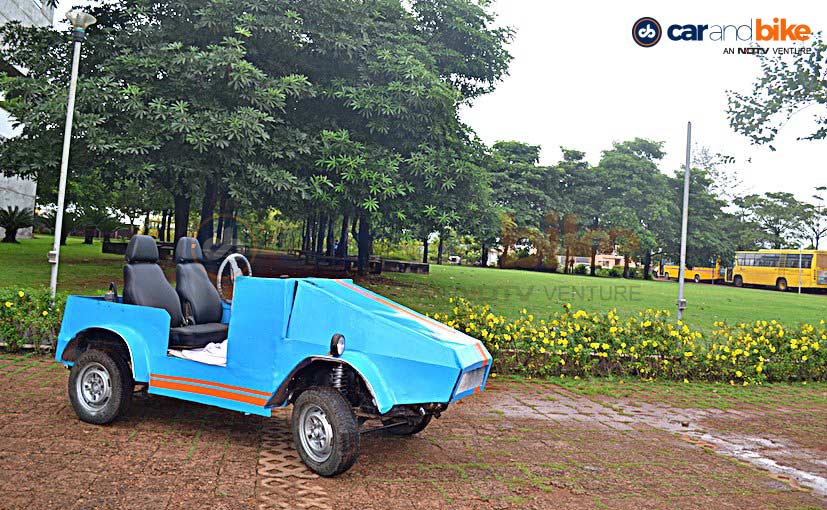
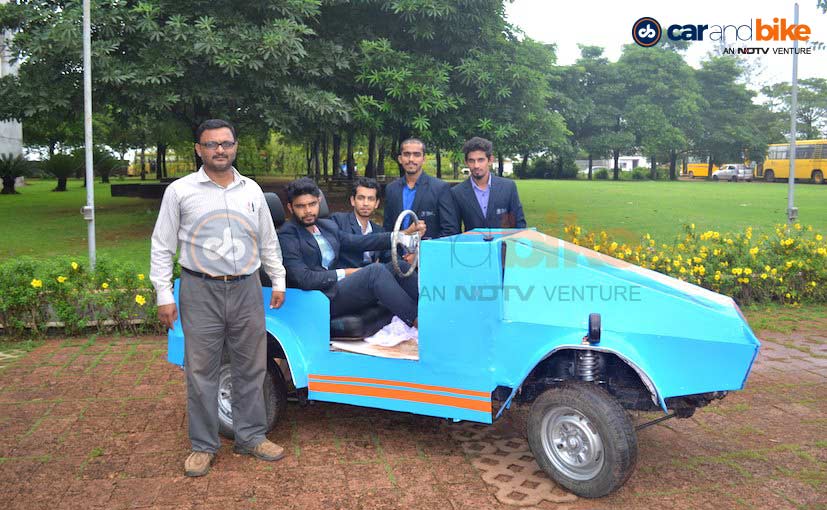
Another factor that helped students achieve the higher fuel economy was the design overhaul. Unrecognisable as a people's carrier, the Maruti Omni has been chopped to be created into a convertible with a fibreglass body. The kerb weight then was brought down to 700 kg, a whole 100 kg lower than the Omni's stock weight, while the steering assembly was moved behind on the twin-seater, for ease of access.
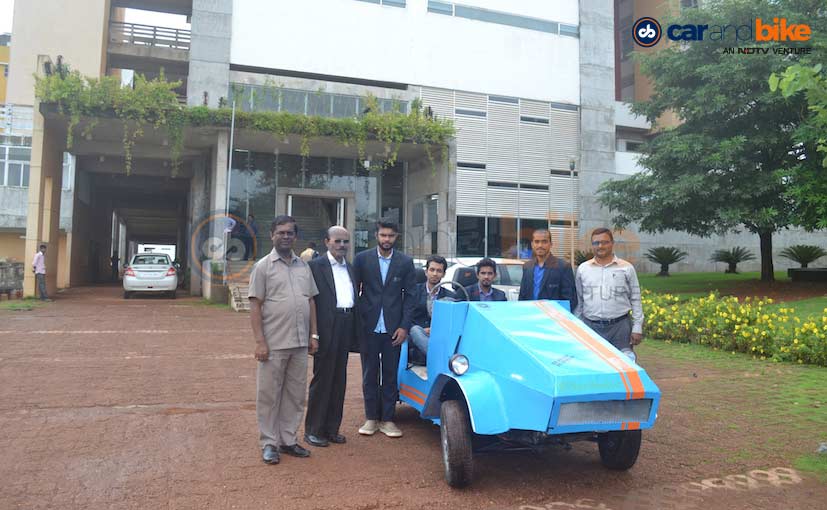 The BIT engineering students spent Rs. 1 lakh in the development of the complete project, while the electrolysis machine itself costs Rs. 10,000. As interesting as this is, it will be even more exciting to see how this technology can be adopted into the real world, within the parameters of safety norms, of course. That said, it is indeed at a nascent stage but it’s a new direction to using alternate fuels. However, what intrigues us even more now is the next engineering project that BIT plans to make, a fully hydrogen fueled car.
BIT Water Hybrid Car Team
BIT Water Hybrid Car Side Profile
BIT Water Hybrid Car is based on the Maruti Omni
The BIT Water Hybrid Car uses electrolysis process to separate hydorgen and oxygen
Yes, those figures are in the same vicinity as the stock Maruti Suzuki Ciaz or Celerio diesel. But, the water hybrid tech works with diesel cars as well and given the fact that this technology can be installed as an add-on, on any of these cars, you can see the scope of improvement. However, unlike the sulphur emitting oil burner that diesel tends to be, a large part of the BIT Hybrid car's emissions is water vapour. At a time when Toyota and Honda have been actively working and promoting hydrogen-powered vehicles (Toyota Mirai and Honda FCV Clarity), what you have here is hydrogen hybrid technology being utilised in its most basic form.Another factor that helped students achieve the higher fuel economy was the design overhaul. Unrecognisable as a people's carrier, the Maruti Omni has been chopped to be created into a convertible with a fibreglass body. The kerb weight then was brought down to 700 kg, a whole 100 kg lower than the Omni's stock weight, while the steering assembly was moved behind on the twin-seater, for ease of access.
The BIT Water Hybrid Car project cumulatively cost Rs. 1 lakh
Related News


Latest Cars


Upcoming Cars


Latest News


 car&bike Team | Aug 4, 2026Porsche India Launches Buyback Plans For Cayenne, Macan Electric and TaycanThe offer covers an Assured Buy-Back Guarantee for 36 Months (3 Years) from the date of sale of the car.1 min read
 car&bike Team | Aug 4, 2026Updated Bajaj Pulsar N160 Spotted on TestBajaj is planning to launch as many as 10 updated models over the next few months and one of them is expected to be the new Pulsar N160, which has been spotted on test.1 min read
 car&bike Team | Aug 4, 2026KTM 390 Adventure S, Adventure R Prices Increased By Rs 8,000 In IndiaKTM has revised the prices of the 390 Adventure S and Adventure R, with both motorcycles now costing Rs 8,000 more than before.1 min read
 Jaiveer Mehra | Aug 3, 2026Michelin Launches First India-Made Passenger Car Tyres; New Primacy 5 Range Prices Start at Rs 10,000The company unveiled plans last year to launch India-made passenger car tyres.4 mins read
 car&bike Team | Aug 3, 2026Two-Wheeler Sales July 2026: TVS, Honda, Suzuki, Royal Enfield And Bajaj Report Strong GrowthJuly 2026 remained good for India's two-wheeler industry, with most manufacturers reporting healthy year-on-year growth.3 mins read
 Preetam Bora | Aug 3, 2026Opinion: Norton Needs More Than World-Class MotorcyclesTVS is betting big on Norton Motorcycles. The strategy seems to be a product onslaught led by a V4 superbike, a middleweight adventure tourer, and more in the pipeline. Should TVS have also focussed on Norton’s legacy and history?7 mins read
 Bilal Firfiray | Aug 1, 2026Toyota Hilux Review: The InvincibleMarking it as the ninth generation, the Hilux comes with a major cosmetic overhaul. But is it still relevant enough for the current times or is it getting too long in the tooth?5 mins read
 Bilal Firfiray | Jul 30, 2026Kia Syros EV Review: Best EV To Buy Under Rs 20 Lakh?The Kia Syros EV comes into the game with a modern design, spacious cabin, strong performance, decent range and an aggressive pricing. But could it become the new benchmark under Rs 20 lakh?5 mins read
 Jaiveer Mehra | Jul 27, 20262026 Maruti Suzuki Brezza Facelift Review: Bestseller Joins The Turbo ClubWhile Maruti’s facelifts have always tended to bring subtle updates over the outgoing models, the latest Brezza brings some heavy updates under the skin, including a new 6-speed manual gearbox and, for the first time, a turbocharged petrol engine option.1 min read
 Bilal Firfiray | Jul 24, 2026Honda ZR-V Review: Who Is It For?Honda has brought the new ZR-V to India as their current flagship offering. It’s a CBU, it’s a hybrid, and it’s here for a limited few. Who is it for though?1 min read
 Girish Karkera | Jul 29, 2026Mercedes-AMG E53 4MATIC+ PHEV First Drive Review: Just What The Doctor OrderedThere are luxury cars and there are high-performance cars. But what if you want both for the price of one? Mercedes-Benz has a recommendation that promises to tread a fine line between the two – the second generation E53 with a twist.7 mins read